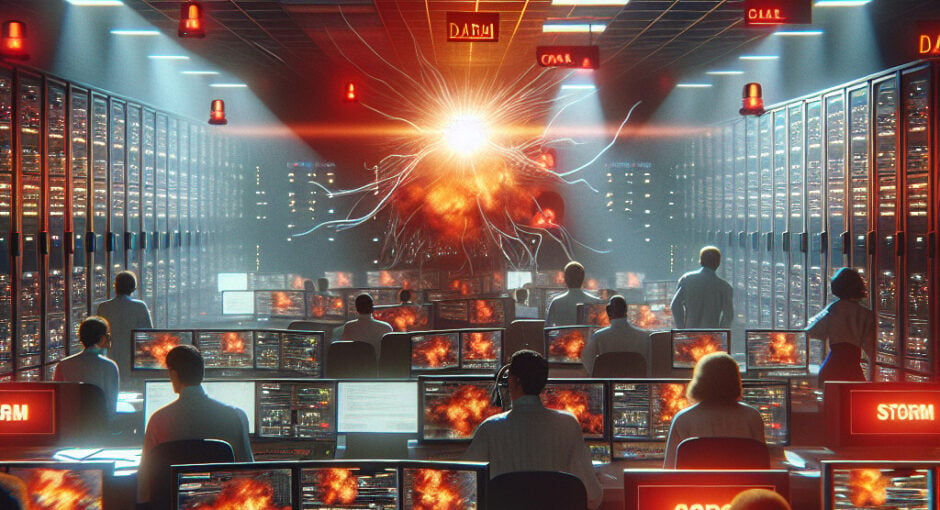

When you run facility controls at scale — chilling megawatts of IT load, regulating air handlers the size of buses, and keeping backup power ready in milliseconds — your network isn’t “just IT.” It’s a life support system for the building.
And yet, in many hyperscale data centers, that network still leans heavily on Layer 2 designs drawn from simpler times. In small facilities, Layer 2 Ethernet is easy. In an environment with thousands of controllers… it’s a ticking time bomb.
What’s the Problem With Layer 2?
Layer 2 creates a flat Ethernet switching domain. It’s great for plug-and-play: devices share a network, talk directly using MAC addresses, and life is good — until something goes wrong.
The most infamous failure: the broadcast storm.
A broadcast storm happens when one (or more) devices send continuous broadcast packets, or looping traffic floods the network. Layer 2 happily forwards broadcasts to all nodes in the VLAN. In a big building management system (BMS) or SCADA-type network, this means:
- Controllers can be overwhelmed and stop responding.
- Central control panels go “blind” to field devices.
- Fail-safes trigger, potentially ramping cooling to max or killing chilled water pumps.
- Equipment alarms cascade, sometimes tripping systems into degraded mode.
In a hyperscale facility where every second of thermal or electrical stability matters, a network storm isn’t just bad — it’s catastrophic.
Why Storms Hurt So Much in Layer 2 Networks
In the classic Layer 2 BMS topology, devices are organized into VLANs and connected to redundant Layer 2 switches in star or ring configurations. Redundancy is handled by Spanning Tree Protocol (STP)or vendor “self-healing ring” mechanisms.
The issues are:
- Broadcast storms are per VLAN and can take out every device in that VLAN.
- STP blocks links until a failure, which wastes bandwidth.
- Failover from link failure can take multiple seconds.
- Troubleshooting is complex — is the problem the device, the VLAN, or a loop?
- As you add controllers, the size of each broadcast domain grows — and so does the blast radius of any storm.
How Layer 3 Solves the Problem
Layer 3 is what the internet runs on — routing, not just switching.
Here’s the key difference: Layer 3 breaks up the network into multiple routed subnets. Broadcasts never cross the subnet boundary, and you have full control over the traffic between them.
In a Layer 3 facility control network, each plant subsystem (Airside Cooling, Waterside Chillers, UPS Control, etc.) lives in its own VLAN and has its own IP subnet. The aggregation switches route traffic between these subnets.
Benefits:
- 🚫 Broadcast storm containment — a storm in one subnet stays there.
- ⚡ Active-active redundancy with routing protocols like OSPF — no idle links.
- 🛡 Security controls — you can firewall between systems, e.g., prevent a cooling controller from talking to a generator controller except through approved gateways.
- 📈 Scalability — new plant gear gets its own subnet, instead of stretching the L2 fabric.
- 🔍 Easier troubleshooting — routing tables and ping/traceroute make isolating failures faster.
Layer 2 vs. Layer 3 for Data Center Controls
| FEATURE | LAYER 2 TODAY | LAYER 3 FUTURE |
|---|---|---|
| Segmentation | VLANs only (same broadcast domain per VLAN) | VLANs + IP subnets routed between them |
| Redundancy | STP or ring protocols; blocked links | Routing protocols (OSPF, ECMP); all links active |
| Storms | Storm in VLAN affects all devices in VLAN | Storm stays contained to 1 subnet |
| Security | Limited ACLs; mostly flat | Full inter-subnet ACL/firewall capability |
| Scale | Requires careful STP/VLAN planning | Just add subnets; low risk of cross-system contamination |
| Failover Speed | Seconds (STP reconvergence) | Sub-second (fast routing failover) |
A Real-World Migration Path
Moving hyperscale control networks from Layer 2 to Layer 3 isn’t futuristic — it’s happening right now in IT networks, and facility networks should follow:
- Enable Layer 3 switching at the aggregation/distribution level.
- Assign a unique IP subnet per plant subsystem.
- Deploy a routing protocol for redundancy.
- Retain local hardwired fail-safes for operational safety.
- Use Layer 3 ACLs/firewalls to separate critical functions.
The Bottom Line
If you run a data center, you cannot afford for a $100 device spewing garbage packets to bring down a billion-dollar facility. Yet in a flat Layer 2 topology, that’s exactly what can happen.
Layer 3 is a fundamental topology change that:
- Limits failure blast radius
- Improves redundancy efficiency
- Enhances security
- Prepares your facility controls for growth
Network storms can ruin a data center. Broadcast domains should be small, controlled, and well-defended.
It’s time for hyperscale operators to treat their control networks with the same design principles that keep the global internet running — because your uptime depends on it.




Social Profiles