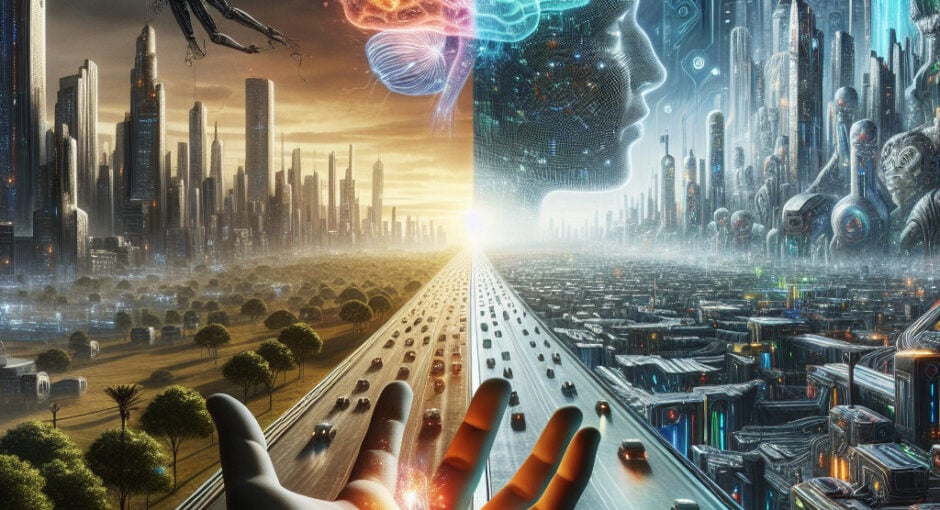

Aldous Huxley’s Brave New World and George Orwell’s 1984 offer chilling visions of futures where technology is used to manipulate and control individuals. While these novels serve as potent warnings, they also provide a framework for understanding the potential pitfalls and possibilities of artificial intelligence (AI) as it becomes increasingly integrated into our lives. By examining the power structures, psychological manipulation techniques, and societal implications depicted in these dystopian worlds, and how they might manifest in specific technologies, we can better navigate the ethical challenges and choices that lie ahead in our own AI-driven future.
Power Structures: Centralization vs. Decentralization
Brave New World depicts a society where power is centralized in the hands of a technocratic elite who use advanced technology and psychological conditioning to maintain stability and control. This control is achieved through the manipulation of pleasure, with citizens conditioned from birth to embrace conformity and instant gratification. In contrast, 1984 presents a more overtly oppressive power structure where the Party, led by Big Brother, maintains total control through surveillance, propaganda, and fear.
Modern AI sits at the crossroads of these dystopian visions. Tech giants like Google and Facebook centralize vast troves of personal data, making their power both immense and insidious. Their sophisticated algorithms can shape public opinion, subtly nudging behaviors and preferences. Simultaneously, decentralized AI initiatives seek to distribute power, although their impacts remain hindered by resource constraints and technical complexity. The tension between centralized influence and the democratization of AI technologies echoes the power dynamics of Huxley and Orwell’s worlds.
Psychological Manipulation Techniques: Subtlety vs. Coercion
In Brave New World, psychological manipulation is subtle and pervasive, relying on techniques like hypnopaedic learning and the use of pleasure-inducing drugs to ensure compliance. 1984, on the other hand, employs more coercive methods, including thought control, surveillance, and torture, to enforce conformity and suppress dissent.
Today, AI-driven applications wield psychological influence with both subtlety and coercion. Social media algorithms subtly curate content to generate engagement, creating echo chambers that reinforce existing beliefs and stoke divisiveness. On the coercive front, state surveillance programs deploy AI to monitor public and private communications, reminiscent of Orwell’s Thought Police. The rise of deepfake technology further complicates the digital landscape, challenging our very perception of truth and authenticity.
Societal Implications: Homogeneity vs. Totalitarianism
Brave New World portrays a homogeneous society where individuality is sacrificed for stability and conformity. 1984 depicts a totalitarian state where the individual is completely subservient to the Party. Both novels warn of the dangers of technology being used to suppress individual freedom and create a society where critical thinking and dissent are stifled.
Modern AI has the dual capacity to foster homogeneity or veer towards totalitarianism. Personalization algorithms, while enhancing user experience, often create filter bubbles that limit the diversity of ideas, fostering a homogenized digital environment. Conversely, AI-driven surveillance technologies hold the potential for unparalleled intrusion into personal lives, echoing Orwellian totalitarian control. The implications for personal freedom and societal health are profound, necessitating vigilant ethical oversight and robust regulatory frameworks.
AI and Everyday Life: From Traffic to Education
The potential for AI to be used for both utopian and dystopian purposes can be seen in its application across various aspects of everyday life:
Traffic Cameras: Efficiency vs. Surveillance
Brave New World: Imagine AI-driven traffic cameras that not only monitor traffic but also analyze real-time data to optimize flow and reduce congestion. For example, Singapore already uses AI-powered systems to manage traffic, adjusting signal timings to prevent jams. In Huxley’s society, these cameras would prioritize societal efficiency and public safety, ensuring predictability and order (Helbing, et al. “The Future of Smart Traffic Control: Simulations and Experiments to Assess AI Efficacy”). Moreover, AI could be used for immediate detection and resolution of accidents, minimizing disruptions and maintaining a harmonious flow of life.
1984: In Orwell’s future, these same cameras would evolve into omnipresent surveillance tools. China’s extensive use of facial recognition technology exemplifies how AI can identify and track individuals in real-time (“Facial Recognition: Top AI Use Cases and Applications”). Every citizen’s movement could be monitored and recorded, with deviations from predetermined norms flagged for investigation. The recent rollout of “social credit systems” in various Chinese cities, which rate citizens based on their behavior and adherence to laws, can be seen as an early stage of this surveillance model (Creemers, Rogier. “China’s Social Credit System: An Evolving Practice of Control”).
Email: Filtered for Harmony or Monitored for Dissent
Brave New World: AI could create personalized email filters to manage stress and enhance productivity. Google’s AI-based Smart Reply and Smart Compose features already offer a glimpse into this future. In Huxley’s world, these would evolve to censor stressful topics, ensuring communications align with societal positivity (Nayak, Prabhakar Raghavan and Samsher R. “Smart Compose: Automated Email Response Generation”) . Additionally, companies might employ sentiment analysis to detect and mitigate workplace stress, promoting a happier, more stable environment.
1984: Conversely, Orwell’s society would utilize AI to monitor email communications for subversive content. Natural language processing (NLP) technologies could analyze emails for dissenting phrases or “thoughtcrimes.” Palantir’s software is an example, where its predictive analytics are used to identify potential threats by analyzing vast amounts of communication data (“The Controversial Role of Palantir in Predictive Policing”). Such tools would integrate seamlessly into a regime focused on maintaining ideological purity, flagging individuals for re-education or punishment.
News Media: Positive Spin or Propaganda
Brave New World: AI in news media would curate content to support societal stability and happiness. The Washington Post’s Heliograf, an AI-driven news-writing platform that generates personalized news summaries, offers a preview of this technology (Dorr, Áine. “The AI Journalism Revolution – From Heliograf to Automated Insights”). In Huxley’s society, AI would ensure that news articles emphasize positive stories and minimize distressing content, contributing to an overall sense of well-being and stability.
1984: Orwell’s vision would see AI manipulating news to fit the ruling party’s narrative. Deepfake technology, which can create hyper-realistic fake videos, illustrates how AI can distort reality (Chesney, Robert & Citron, Danielle K. “Deepfakes and the New Disinformation War: The Coming Age of Post-Truth Geopolitics”). Combined with AI-driven content generation, state-controlled news could present a fabricated reality that reinforces the Party’s ideology. The pervasive use of such technology would create a controlled information environment where dissent is not only discouraged but made seemingly irrational.
Public Education: Tailored Learning or Indoctrination
Brave New World: AI could revolutionize education by providing personalized learning experiences. Platforms like Coursera and Khan Academy already use AI to adapt courses based on user engagement (Advance, Carol. “How Khan Academy Is Redefining Education With Artificial Intelligence”), guiding students smoothly along their educational journey. In Huxley’s society, AI would further refine this adaptive learning to ensure each individual fits perfectly into their societal role, fostering collective efficacy and stability.
1984: In contrast, Orwell’s society would employ AI for indoctrination. AI-driven educational platforms could subtly manipulate learning materials to instill loyalty to the state. Algorithms similar to YouTube’s recommendation system, which has been criticized for pushing extremist content, could be used instead to reinforce Party ideology (Covington, Paul; Adams, Jay & Sargin, Emre. “Deep Neural Networks for YouTube Recommendations”). AI tutors would monitor students for signs of dissent, ensuring any deviation from Party orthodoxy is corrected promptly.
Beyond Dystopia: A Star Trek Future?
While Brave New World and 1984 offer cautionary tales, it is essential to remember that the future of AI is not predetermined. Star Trek presents a more optimistic vision, where AI is used to empower individuals, promote social justice, and advance the common good. Technologies like the replicator, the universal translator, and the holodeck illustrate the potential for AI to enhance human capabilities and create a more equitable and harmonious society.
To achieve this positive future, we must actively steer AI development in an ethical direction. This requires promoting transparency, accountability, and fairness in AI systems, and ensuring that AI technologies are used to serve humanity rather than control it. By embracing the values of exploration, cooperation, and respect for all life, we can harness the power of AI to create a future where technology empowers humanity and unlocks our full potential.
Conclusion
In scrutinizing Brave New World and 1984, we uncover nuanced insights into power dynamics, psychological manipulation, and societal outcomes. Huxley’s world, deceptively serene through pleasure, and Orwell’s, starkly oppressive through fear, both unveil the potential futures shaped by AI. Our path forward demands a balance—leveraging AI to enhance human creativity and societal progress while staunchly guarding against the perils of control and conformity. As we chart this course, ethical integrity and respect for human autonomy must remain our guiding principles, ensuring that AI serves as a tool for empowerment rather than subjugation.
Bibliography:
- Google AI. “Google AI.” Google, https://ai.google/.
- Facebook AI. “AI Research.” Facebook, https://ai.facebook.com/.
- Zuboff, Shoshana. The Age of Surveillance Capitalism. PublicAffairs, 2019, https://www.penguinrandomhouse.com/books/246858/the-age-of-surveillance-capitalism-by-shoshana-zuboff/.
- Xu, Beina. “China’s Mass Surveillance Program.” Council on Foreign Relations, 2021, https://www.cfr.org/backgrounder/chinas-mass-surveillance-program.
- Pariser, Eli. The Filter Bubble: What the Internet is Hiding from You. Penguin Books, 2012, https://www.penguinrandomhouse.com/books/209916/the-filter-bubble-by-eli-pariser/.
- O’Neil, Cathy. Weapons of Math Destruction: How Big Data Increases Inequality and Threatens Democracy. Crown Publishing Group, 2016, https://weaponsofmathdestructionbook.com/.
- Chesney, Robert, and Danielle Citron. “Deepfakes and the New Disinformation War: The Coming Age of Post-Truth Geopolitics.” Foreign Affairs, Council on Foreign Relations, 2019, https://www.foreignaffairs.com/articles/world/2018-12-11/deepfakes-and-new-disinformation-war.
- Helbing, Dirk, et al. “The Future of Smart Traffic Control: Simulations and Experiments to Assess AI Efficacy.” Computational Social Sciences, Springer, 2019.
- Advance, Carol. “How Khan Academy Is Redefining Education With Artificial Intelligence.” EdTech Magazine, 2020, https://edtechmagazine.com/k12/article/2020/01/how-khan-academy-redefining-education-artificial-intelligence.
- Covington, Paul, Jay Adams, and Emre Sargin. “Deep Neural Networks for YouTube Recommendations.” Proceedings of the 10th ACM Conference on Recommender Systems (RecSys 2016), 2016, https://dl.acm.org/doi/10.1145/2959100.2959190.







Social Profiles