
How We Built an Autonomous Assurance Engine—and Why It Changed Everything
Most security leaders don’t lose sleep over whether policies exist. They lose sleep over whether those policies will hold up under audit.
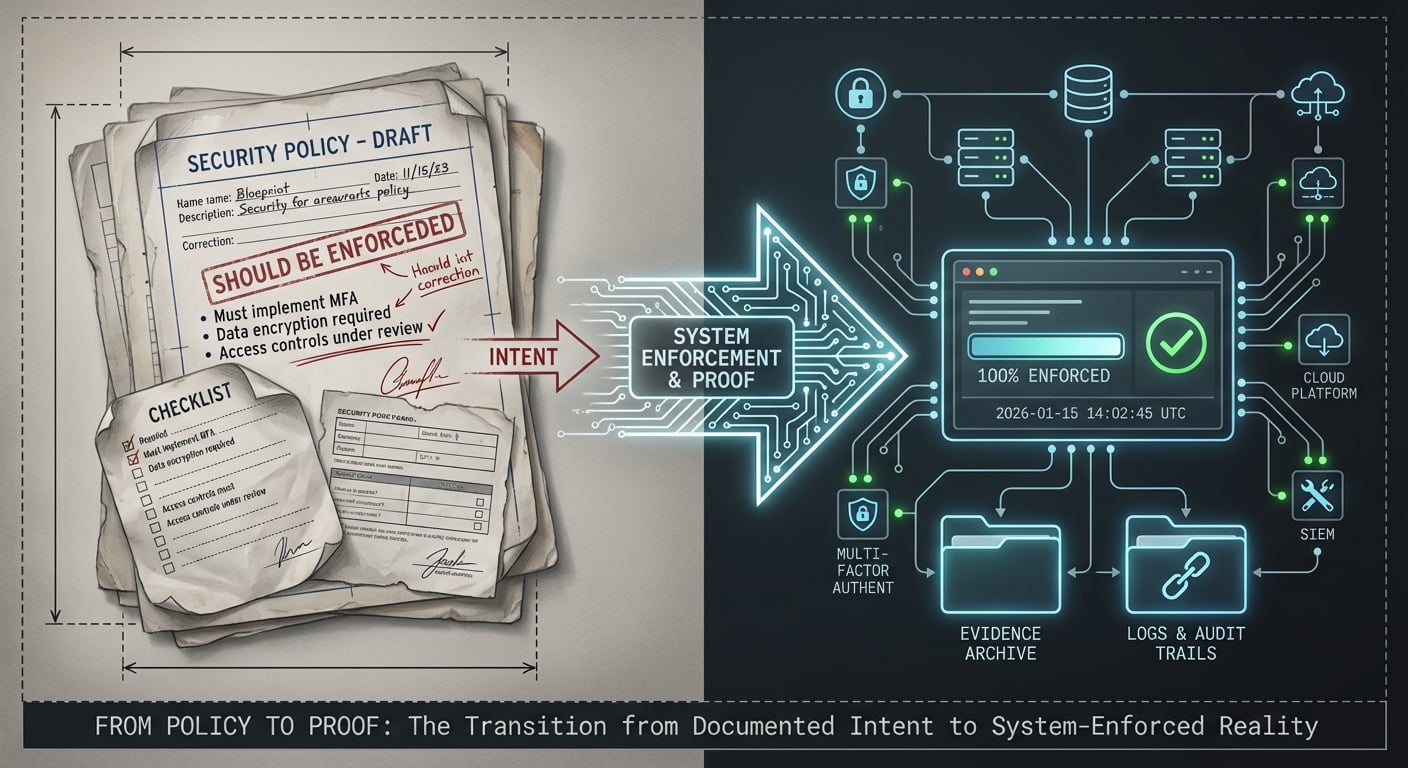
The uncomfortable truth is that traditional compliance lives in documents, while real security lives in systems. The gap between the two is where audits fail—not because teams are reckless, but because proof is assembled too late, too manually, and too inconsistently.
Over the last quarter, we set out to close that gap. What emerged was not a faster audit checklist—but an Autonomous Assurance Engine.
This is the story of how it works, what changed, and why it matters.
The “Paper Tiger” Problem
Imagine building a skyscraper like this:
- The blueprints are locked in a filing cabinet
- The construction crew works from memory and best guesses
- The safety inspector shows up once a year
- When they do, everyone runs around taking photos to prove the building is safe
That’s traditional cybersecurity compliance.
Policies are beautifully written PDFs. Engineers configure systems based on experience. Auditors ask for screenshots. And compliance becomes a last-minute scramble instead of a continuous state.
The result? Lots of paperwork. Very little assurance.
The Core Insight: Compliance Is Not Documentation
Most compliance programs operate on an implicit assumption:
“If the policy exists, and the team follows it, we’ll figure out proof later.”
Auditors operate on a different assumption:
“If it isn’t explicit, scoped, enforced, and evidenced—it doesn’t exist.”
We decided to design for the auditor’s assumption from the beginning.
That led us to a simple operating model:
Truth → Fix → Proof → Reality
Not as a slogan—but as an architecture.
Phase 1: Truth — Establishing an Unforgiving Baseline
Every journey starts with brutal honesty.
We fed the system exactly what an auditor sees: security policies, control mappings, and scope statements. No interviews. No clarifications. No “we usually do this.”
The Autonomous Auditor analyzed 200 controls across 18 policy sheets and graded them on one question:
Is this requirement clear, scoped, owned, enforceable, and auditable?
No assumptions. No benefit of the doubt.
The result was a moment of clarity.
==================================================
       AUDIT SCORECARD
==================================================
COMPLIANCE SCORE: 1.5%
------------------------------
Sheets Processed:    18
Total Controls:      200
Fully Implemented:   3
Gaps / Partial:      197
------------------------------
Recommendation: 🔴 REPEAT PHASE 2 (Remediation Loop)
This was not a security failure. It was a precision failure.
Most controls existed as intent, tribal knowledge, or informal practice. To a machine—or an external auditor—that is indistinguishable from nothing.
The system did what a good auditor does: it told us to fix it.
Phase 2: Fix — The Remediation Loop That Changed the Outcome
This is where most compliance programs stall. We automated it.
Instead of humans debating interpretations, the system treated every failed control as a specific defect: vague scope, passive language, undefined ownership, missing evidence requirements.
A remediation swarm went to work—each agent obsessed with a different failure mode: scope, language, ownership, OT safety, tool enforcement, and evidence definition.
A few examples of what they did:
- Scope Agents expanded vague phrases like “systems” to explicitly include IT, OT, ICS, cloud, and remote sites
- Implementation Agents replaced “should” with MUST, SHALL, and WILL
- OT Adaptation Agents added safety warnings where IT procedures would be dangerous in industrial environments
This wasn’t creative writing—it was structural remediation. We made every control auditable by design.
Forty-five minutes later, we ran the audit again.
The Turning Point: When Proof Replaced Promises
Same controls. Same environment. Same auditor. Different result.
==================================================
       AUDIT SCORECARD
==================================================
COMPLIANCE SCORE: 93.5%
------------------------------
Sheets Processed:    18
Total Controls:      200
Fully Implemented:   187
Gaps / Partial:      13
------------------------------
Recommendation: 🟠 MANUAL REVIEW. Diminishing returns on automation
The jump—from 1.5% to 93.5%—was not because we suddenly became more secure overnight.
It happened because we crossed a structural boundary:
- From intent → enforcement
- From claims → evidence
- From documents → operational artifacts
The remaining 13 controls weren’t automation failures. They were judgment calls, exceptions, or edge cases—exactly where human governance should take over.
That’s why the recommendation wasn’t “fix more.” It was:
🟠 Manual review. Diminishing returns on automation.
That is a successful outcome.
Why the 1.5% Score Was a Feature, Not a Bug
Executives often ask: “How could we possibly be at 1.5%?”
The answer is simple: We finally measured the right thing.
The baseline audit intentionally ignored verbal explanations, historical behavior, “we’ve always done it this way,” implied scope, and good intentions.
It only scored what was explicit, enforceable, assigned, auditable, and provable.
That made the first score uncomfortable—but accurate. And accuracy is the only starting point that matters.
Why the 93.5% Score Is Credible
The final score is conservative by design.
Controls only moved to “Fully Implemented” when:
- Policy language was explicit and mandatory
- Scope included IT, cloud, and OT where applicable
- Ownership was defined
- Procedures were written
- Evidence folders physically existed
- Artifacts passed an automated quality gate
No evidence, no credit.
The remaining 13 controls represent business decisions, risk tradeoffs, and exceptions that require leadership sign-off. That’s exactly where executives belong in the loop.
Phase 3: Proof — Packaging Evidence for Auditors
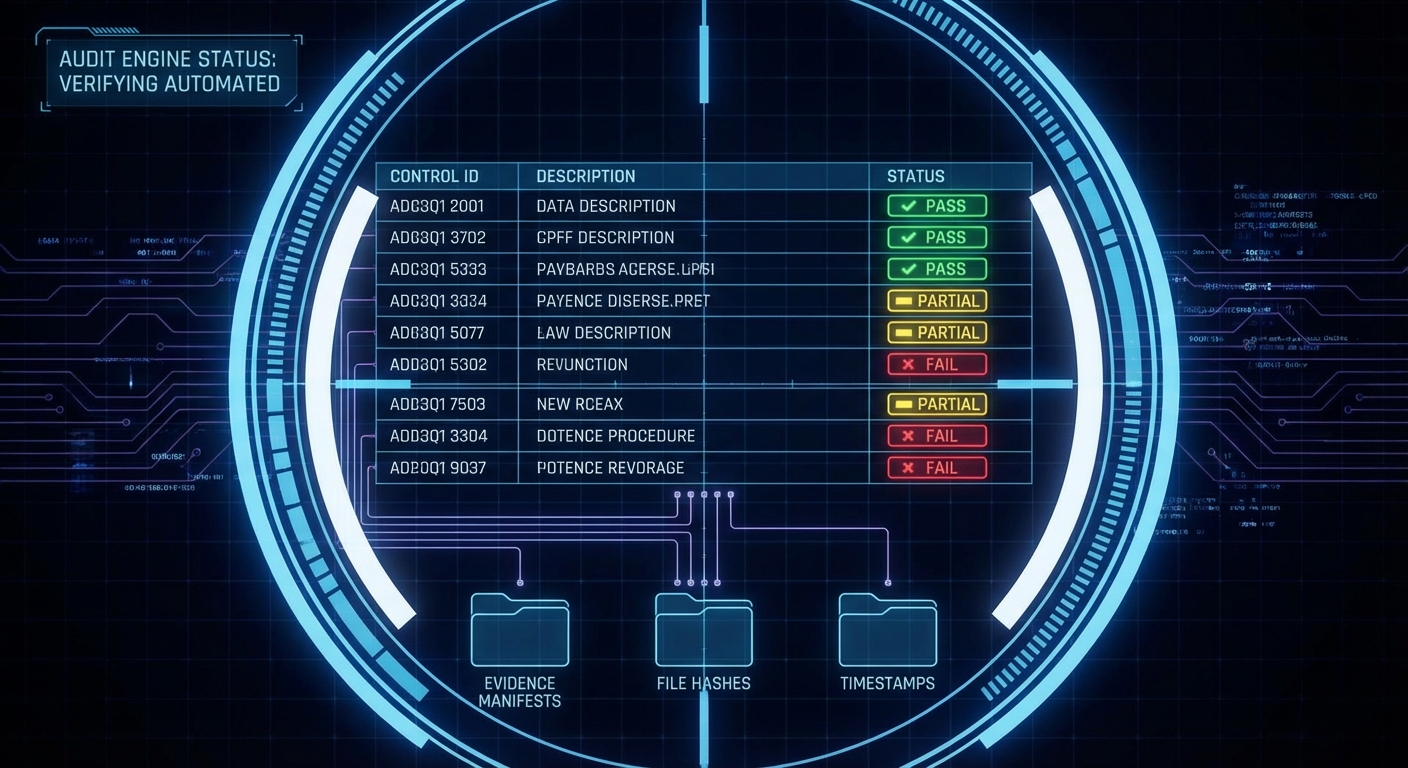
For every control, the system generated a complete Evidence Pack—structured exactly how auditors think:
- Standards — measurable thresholds (“90 days”, “5 attempts”)
- Procedures — step-by-step instructions a junior admin can follow
- OT-Safe Procedures — with explicit safety warnings
- Tool Mapping — whether enforced by Okta, detected by Splunk, or purely procedural
- Evidence Index — a matrix auditors can scan in minutes
Every control became a folder. If the folder was empty, the control was partial. If the evidence existed, the control was fully implemented.
Binary. Fair. Predictable.
Phase 4: Reality — Bridging Policy and Operations
This is the part most compliance frameworks never reach.
In Phase 4, policies stop being documents and start being operational instructions:
- Standards configure tools
- Procedures tell humans exactly what to do
- Evidence requirements are explicit
- An automated Auditor Bot checks completeness before any human review
By the time a real auditor arrives, the question isn’t “Can you prove this?” It’s “Which folder would you like first?”
How the Machine Thinks: Building Intuition
For those curious about the mechanics—without the code—here’s how the system actually works.
1. Single-Purpose Agents, Not One Big Brain
The system doesn’t use a single AI trying to do everything. Instead, it deploys a swarm of specialists, each with exactly one job:
- The Scope Agent only cares about one thing: “Does this policy explicitly cover IT, OT, ICS, cloud, AND remote sites?” If not, it expands the scope. Nothing else.
- The Consistency Agent only asks: “Is this structured like a real policy? Are roles named? Are headers standardized?”
- The Implementation Agent has a single obsession: mandatory language.
This separation matters. A generalist AI might “improve” a policy in ten directions at once, creating inconsistency. A specialist agent makes one precise fix—and stops.
2. The “Forbidden Lexicon” — Words the System Cannot Write
One of the most effective design choices was giving agents a blocklist of weak language:
“should”, “may”, “strive to”, “best effort”, “typically”, “recommended”, “where possible”
The Implementation Agent literally cannot output these words. If the input contains “should,” the output must contain “shall” or “must.” No exceptions.
This isn’t about tone. It’s about auditability. “Should” is advice. “Shall” is a requirement. Auditors know the difference.
3. Confidence Scoring — Not All Mappings Are Equal
When the system maps a control to a tool, it doesn’t just say “covered.” It assigns a confidence level:
| Confidence | What It Means |
|---|---|
| High (0.9+) | Exact tool name from authorized catalog. Owner known. Evidence type specific. |
| Medium (0.7–0.8) | Tool class known (e.g., “a SIEM”) but no specific name. Owner TBD. |
| Low (<0.7) | Purely inferred. No tool. No owner. Generic evidence. |
Low-confidence mappings get flagged. The system doesn’t hide uncertainty—it surfaces it.
4. Coverage Classification — How Tools Actually Work
Not all tools enforce the same way. The system classifies coverage into distinct categories:
- Enforced: Technical block. The tool prevents the bad thing (e.g., IAM denying access).
- Detective: The tool sees the bad thing after it happens (e.g., SIEM alert).
- Procedural: No tool. A human follows a process.
- Compensating: The standard control doesn’t apply, but something else mitigates the risk (e.g., air gap in OT).
- Inherited: The control is satisfied by a parent system (e.g., AWS physical security).
- Not Covered: Gap. Needs remediation or exception.
This classification drives audit conversations. “Enforced” gives you high assurance. “Procedural” requires sampling and interviews. Auditors think this way—so the system does too.
5. Catalog Grounding — Preventing Hallucination
One of the biggest risks with AI-generated compliance content is hallucination—inventing tools, roles, or capabilities that don’t exist.
We solved this with catalog grounding. Before any agent runs, it loads:
- An Authorized Tool Catalog (with canonical names, owners, and IDs)
- An Acronym Dictionary (so “SIEM” always expands the same way)
- An Organizational Role List (real titles, not generic “Management”)
Agents must select from these catalogs. If a tool isn’t in the catalog, the agent can suggest a generic class—but it can’t invent a specific name.
This is how you get precision at scale.
6. The SME Quality Gate — Machines That Doubt Themselves
The final pass before any output is accepted is the SME (Subject Matter Expert) Agent. Its job is adversarial:
- If the draft claims “Fully Implemented” but the evidence is thin → downgrade
- If the draft is overly cautious but evidence proves operation → upgrade
- If the control has multiple parts and only one is addressed → flag incomplete
The critical rule: Evidence beats narrative. If there’s a conflict between what the draft says and what the evidence shows, evidence wins.
This is how the system stays honest.
7. Context Recovery — What Happens When Things Break
Sometimes the system encounters a control with missing context—no question, no clear requirement. Instead of failing silently, an Escalator Agent kicks in.
It reconstructs the missing context by:
- Looking up the Control ID against NIST/ISO frameworks
- Mapping to known capabilities in the catalog
- Generating a precise question the auditor should be asking
This keeps the pipeline moving while surfacing gaps explicitly.
8. The Evidence Pack as Proof
The final artifact isn’t a report. It’s a folder:
/AC-2 Account Management/
├── Manifest.json           ← Machine-readable metadata
├── Evidence_Index.md       ← Human-readable summary
├── Attestation.md          ← Sign-off template
├── Standards/
│   └── STD-AC-2-01.md      ← Measurable thresholds
├── Procedures/
│   ├── PROC-AC-2-01.md     ← IT procedure
│   └── PROC-OT-AC-2-01.md  ← OT-safe version with safety warnings
└── Artifacts/
    └── (collected evidence goes here)
When an auditor asks “Show me AC-2,” you hand them this folder. Everything they need is in one place, organized the way they think.
Why This Matters to Technical Leadership
Traditional audits take 4–6 weeks, produce uncertain outcomes, rely on last-minute evidence collection, and fail late.
This system assesses in minutes, remediates automatically, generates deterministic evidence, and predicts audit outcomes in advance.
More importantly, it changes the role of leadership.
Instead of asking: “Are we compliant?”
You can now ask: “Which controls are enforced, which are procedural, and which require risk acceptance?”
That’s governance at the right altitude.
The Strategic Shift: From Compliance as Labor to Compliance as Infrastructure
The biggest takeaway for leadership is this: We didn’t make compliance faster. We made it structural.
Once compliance is encoded as systems—capabilities, standards, procedures, tool enforcement, and evidence graphs—it stops being a recurring project and becomes infrastructure.
Infrastructure scales. Heroics don’t.
Beyond Cybersecurity: Automated Governance
We started with security because the stakes are high. But the pattern is universal.
- Legal: Read every contract, flag non-standard clauses, generate exceptions
- Finance: Validate SOX controls against live ERP configurations
- Supply Chain: Verify vendor adherence to new regulations overnight
Anywhere rules exist and reality drifts, this model applies.
Compliance shouldn’t be a department. It should be code.
Executive Takeaway
If you remember only one thing from this article, let it be this:
Compliance is not a document problem. It’s a systems problem.
Once treated as a system, the results stop creeping upward. They jump.
And when automation tells you to stop and let humans decide—that’s not a limitation. That’s maturity.





Social Profiles