

When you develop and build hyperscale data centers—and especially when you live in the world of outside-plant fiber, entrance vaults, zero manholes, and meet-me rooms—you respect the clock of the physical world. Concrete cures at the speed concrete cures. A directional bore under a highway takes as long as the rock says it takes. Reviewing sixteen revisions of a 48×36-inch underground conduit layout takes a sharp pair of eyes, a scale bar, and a quiet afternoon.
Then, over the last few months, something strange happened to my nights and weekends.
I started building an internal intelligence engine to tie together the mountain of data we swim in every day: tens of thousands of engineering PDFs, CAD drawings, route maps, endless weekly contractor sync logs, and years of email threads. And somewhere along the way, I stopped using AI like a chatbot and started running it like an engineering firm.
Suddenly, I didn’t have one assistant. I had a hundred parallel sessions running at the same time.
The Rush of “Unlimited Staff”
If you haven’t experienced this shift yet in the IT and infrastructure world, it is genuinely intoxicating at first.
In one terminal window, you have a team of agents auditing 33,000 PDFs overnight, reading every title block, and sorting 13,000 drawing pages by trade—for $38.29 in compute tokens.
In a second window, another workflow is tiling large-format fiber routing sheets, tracing which entrance vaults feed which Point of Entry rooms, and checking whether any manhole violates our path-diversity standards.
In a third window, an agent is reading a 240,000-character rolling construction log and cross-referencing it against equipment purchase orders to prove that a “missing” approval wasn’t missing at all—it was just bought on a direct owner PO and filed in a different folder.
Five years ago, doing all of that at once would have required a twenty-person department, six months of runway, and endless status meetings. Today, it’s a fleet of git worktrees and a token bill. For someone who loves solving systems problems, it feels like strapping on an exosuit.
And that’s right where I walked into the trap.
Two Wake-Up Calls
The first wake-up call came from a dashboard one of my agents built.
I asked for a portfolio view of our active builds. The agent looked at our internal project database, saw some unclosed schedule rows, and proudly generated a page titled “Where We Need to Act”—complete with bright red “ACT” badges lecturing us on which sites were “overdue,” while labeling a massive active build with 1,200 tradespeople on the ground as “Not Scored.”
I stared at the screen and hated it immediately. My colleagues and I have been building data centers together for over twenty years. We don’t need a script with a partial view of the world lecturing us on “where we need to act.” The database row wasn’t overdue because the team was asleep; the project had deliberately paused a package for a power gate. The software was confusing a missing database update with reality.
The second wake-up call was much more personal—and it’s the reason I’m writing this post.
I realized that my own staff members were feeling overwhelmed when I tasked them.
The Physics of the Pitching Machine
It took me a moment to see why. To me, I was just passing along quick, helpful findings from my AI sessions.
“Hey, the drawing audit found four discrepancies between the September 18 and September 23 manhole layouts—can we verify these?”
“Hey, the system noticed ten records missing from the project API—can we get these cleaned up?”
“Hey, here are fifteen open items from the contractor log that look stale—where do these stand?”
Think about the physics of what I was inadvertently doing.
Six months ago, if I wanted to find ten edge-case discrepancies across three continents of construction projects, it took me days of digging through cloud folders and PDFs to uncover them. My own human bandwidth naturally paced how often I handed tasks to my team.
Now, my “unlimited staff” of AI agents was doing three weeks of forensic digging in seven minutes while I drank my morning coffee. And then I was turning around and tossing the resulting tasks to human teammates who:
- Were already in six hours of real-world construction and carrier meetings a day, and
- Didn’t have my AI exosuit on their desks—meaning every time I asked them a “quick question” generated by a 10-agent workflow, they still had to click through folders by hand and read 48×36-inch PDFs by eye to answer me.
I had multiplied my personal output velocity by 20x, while my team was still operating on human clock speed. I had accidentally turned myself into a 150-mph pitching machine in the batting cage, wondering why my favorite hitters were getting exhausted.
Learning Empathy in the Age of Agentic Speed
Realizing that changed how I think about leadership in this new era.
When compute and analysis drop to the cost of tokens, human attention and human morale become the most precious, fragile resources in the building. If you use AI to generate more homework for the people around you, you will burn out the best builders you have.
Over the last couple of weeks, I’ve started enforcing four rules on myself—and on my agents—to protect the humans I work with:
1. Never Hand Out Open-Ended Homework; Hand Out Red-Pen Reviews
When my agents ask me to review something now, I don’t let them dump a raw problem on my lap. I force them to pre-fill the answers with the exact evidence attached, so I only have to mark the exceptions.
Our human teams deserve the exact same respect. If my AI finds a question on a Thai or Japanese telecom drawing, I shouldn’t task an engineer with “Go figure out what changed between Revision 12 and Revision 13.” That’s a three-hour chore. Instead, the AI should do 95% of the legwork—crop the exact title block and manhole table, list the four proposed answers, attach the link—and my note to my teammate should be: “Don’t dig through the drive. The system pulled these 4 numbers from the Sep 23 sheet. Just tell me if any of them look wrong to your eye.”
Turn a three-hour scavenger hunt into a two-minute senior review.
2. Build a Rate-Limiter Between Token Time and Human Time
Agents finish jobs at 2:15 AM on a Tuesday and 11:40 PM on a Saturday. Humans do not.
For one of our internal platform leads, we built a strict rule into the code: even though the system checks for database discrepancies every night, it is only allowed to stage one batched note on Monday morning, and if he hasn’t replied yet, it stays quiet for two weeks.
I realized I needed that same buffer for everyone I manage. Just because Session #47 found something interesting at 9:10 AM doesn’t mean it belongs in someone’s inbox at 9:11 AM. Batch the non-urgent findings. Respect the work-in-progress already on their plate.
3. Always Send the Map With the Question
When an AI searches 40,000 files in four seconds and spots a conflict between an email from May and a drawing from September, it holds the exact file paths and page numbers in memory. If you ask a coworker about that conflict without handing them the exact coordinates, you are forcing a human to play hide-and-seek against a supercomputer. Every question that comes out of an AI workflow should carry the exact breadcrumb trail that produced it.
4. Never Let Software Lecture the People Who Do the Work
We threw out that “Where We Need to Act” dashboard design. Software doesn’t build data centers. Software doesn’t negotiate with utilities, manage general contractors in the mud, or splice 1,728-strand fiber cables in a manhole. People do.
Dashboards and AI agents should state clear, objective facts, organize the blueprints by discipline, and carry the heavy boxes—and leave the judgment to the humans who have the scars.
The Real Job of the Exosuit
It is an incredible time to be an engineer and an architect. Having an “unlimited staff” of AI agents that can read drawings, audit contracts, and watch telemetry 24/7 is the biggest force multiplier I’ve seen in my career.
But the lesson I’m taking into Monday morning is simple: the point of having an unlimited virtual staff isn’t to push your human team harder. It is to use the machines to absorb the friction, the file-hunting, and the grunt work away from your people—so they have the breathing room to do what no token on earth can do.
Epilogue: Building Air-Traffic Control for 88 AI Sessions
By week three, I had a new problem: I was drowning in my own terminal tabs. I felt like I had a hundred sessions open and was spending half my day toggling between windows trying to remember which agent was waiting on my approval and which one had gone off the rails.
So I asked one of the sessions to read the local logs of all the other sessions and build me a Grafana dashboard.
When it lit up, the numbers at the top of the screen made me laugh out loud:

Look at those top tiles—because they capture what managing software looks like when labor is priced in tokens:
- 88 Open Sessions (and 33 “In a Family”): Work no longer happens in one linear thread. One main architectural effort spawns child sessions, adversarial reviewers, and read-only rehearsals.
- 24 “Waiting on You”: Because we run strict safety gates—nothing merges, touches a production schema, or sends an email without a human yes—24 different virtual engineers were standing in line at my desk with their clipboards, waiting for a decision.
- 23 “Wandered From Their Start”: Just like human teams, long-running AI sessions get sidetracked. A session starts out building a database schema, hits a weird backup bug on step 8, and five prompts later it’s debugging storage faults. We actually had to write a drift detector that compares a session’s recent work against its original prompt.
- 5 “Files Two Sessions Edit”: When you have dozens of sessions working in parallel worktrees, they eventually try to edit the same file at the same time.
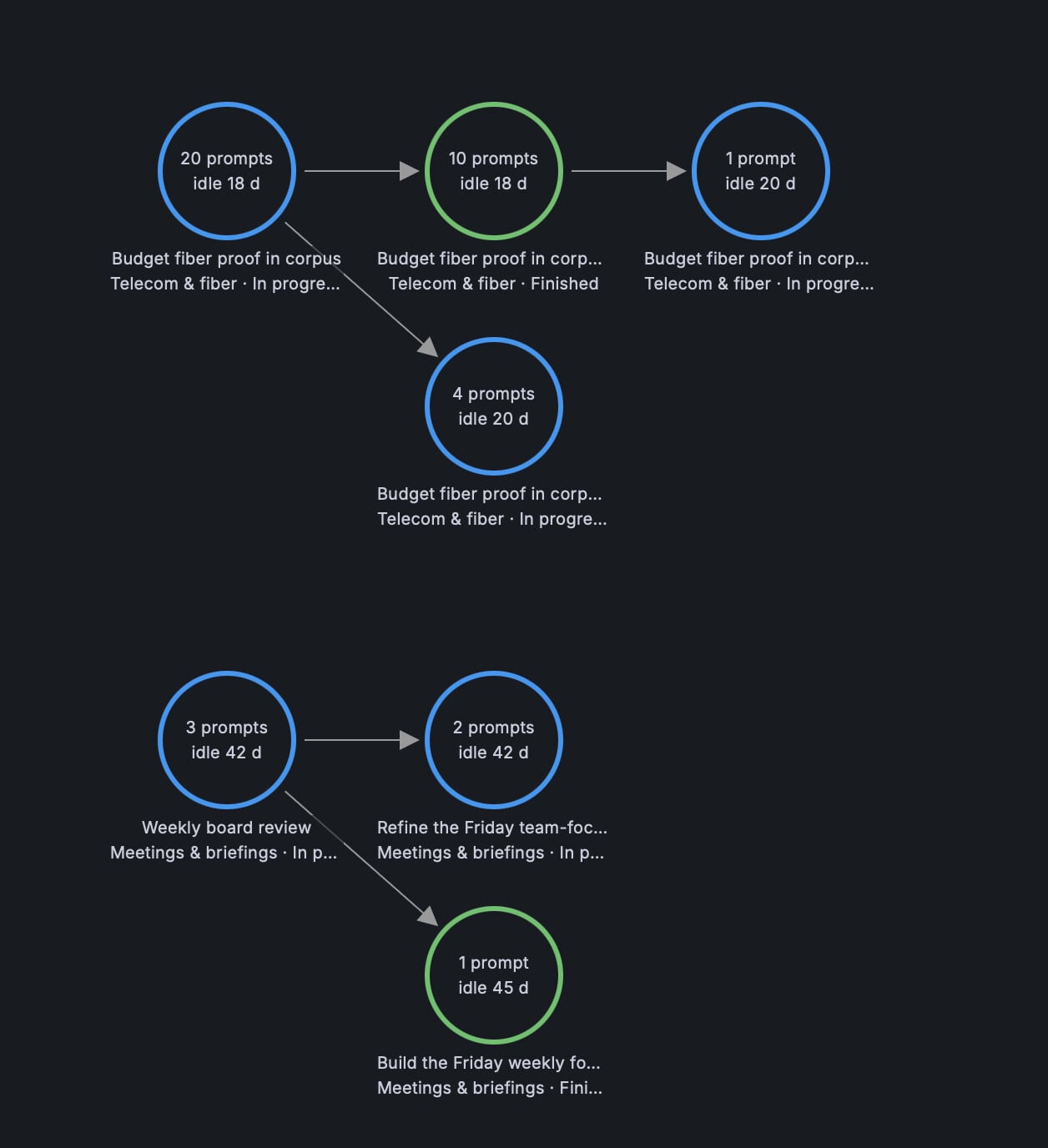
Seeing 24 sessions waiting on me on that screen is what connected the dots about my human team. If I needed a custom Grafana control tower just to survive 24 agents waiting for a “yes/no” decision from me, imagine what it felt like for my human coworkers on the receiving end of those 88 sessions.






Social Profiles